Navigating the Trip from Douglas County for Clinical Exfoliation
Lawrence residents often find that choosing the right aesthetic service means looking slightly beyond Douglas County. While our treatment rooms are located in Overland Park inside KC Injectables Med Spa, the route eastward along K-10 or I-70 provides straightforward access for Lawrence clients. We maintain a single, dedicated location so every consultation focuses fully on evaluating your individual skin barrier before performing any chemical resurfacing.
Many visitors choose to coordinate their appointments around weekly schedules, whether commuting from the University of Kansas campus or traveling from neighborhoods near US-59. Because we do not operate an office in Lawrence, we prioritize thorough upfront discussions to ensure your visit directly addresses your concerns, from persistent surface dullness to product absorption, without requiring unnecessary trips for basic assessments.
Prioritizing Skin Suitability Over the Strongest Available Formula
It is common to assume that a deeper, more aggressive formula yields superior results, but suitability should always guide your choice. Applying a strong chemical peel to skin that is already compromised by aggressive home scrubs or concentrated retinoids can lead to prolonged redness rather than a renewed appearance. Our approach examines your daily skincare products first, ensuring your moisture barrier can safely tolerate professional chemical resurfacing.
If you have been struggling with a rough texture, assessing whether your skin is irritated or merely sluggish is crucial. Over-exfoliated skin requires calming hydration rather than further acid exposure. By identifying your exact skin condition during your consultation, we can select an appropriate peel category that works in harmony with your natural cellular turnover rather than overwhelming your protective outer layer.
Understanding Visible Peeling Versus Meaningful Exfoliation
One of the most frequent questions from clients relates to visible flaking. Many believe that without dramatic shedding, an application has failed to produce benefits. In reality, modern chemical peels often dissolve cellular bonds microscopically. You may notice subtle dusting or simply a smoother feel rather than heavy peeling, yet the treatment may still help lift stubborn dullness and refine surface texture.
Managing expectations regarding uneven-looking tone is equally important. Sun spots, post-breakout marks, and natural pigmentation respond differently to chemical acids, and not every discoloration is suitable for cosmetic peeling. We help you distinguish between superficial pigmentation that may help balance out over time and deeper concerns that might require an entirely different approach or ongoing sun protection strategies.
Aligning Aftercare with Outdoor Life and Kansas Weather Shifts
Living in northeast Kansas brings distinct weather shifts, from dry, blustery winters to intense summer sunshine. Lawrence clients spending sunny afternoons at Clinton Lake or strolling along Massachusetts Street need to plan their post-treatment care carefully. Freshly exfoliated skin is particularly sensitive to ultraviolet rays, requiring committed sun protection, shade-seeking habits, and pausing active outdoor recreation during immediate post-peel recovery.
The cold winter winds that sweep across the Kansas plains can also strip moisture from newly treated skin. When planning your appointment, consider your upcoming seasonal activities and exposure levels. Preparing your home routine with mild, barrier-supporting cleansers and bland moisturizers ensures your post-peel phase remains comfortable, whether dealing with biting midwest winter temperatures or midsummer humidity in Douglas County.
Chemical Peels Versus Supportive Facials and Other Modalities
Choosing between a chemical peel, a supportive facial, or other aesthetic procedures comes down to how each mechanism interacts with your skin. A supportive facial primarily focuses on hydration, gentle pore cleansing, and surface comfort. In contrast, chemical peels utilize specific acids to break down cohesive skin cells, promoting uniform shedding to target rough texture and dull, tired-looking complexions.
If your goal involves clearing surface debris or soothing seasonal dryness, a standard facial might prove more appropriate than a peel. Conversely, if your skin is well-conditioned and you want to address texture variations or mild discoloration, a targeted peel provides deeper cellular exfoliation. Understanding these functional differences ensures you invest in treatments that match your current cosmetic priorities.
Who it may suit
- People deciding whether a peel is the right category of treatment before selecting a named service.
- Clients comparing cosmetic goals such as surface texture, dullness, or uneven-looking tone with realistic recovery preferences.
- Those who want an explanation of how skin history and home products influence peel selection.
- People willing to prioritize suitability over a preference for the strongest-sounding treatment.
- Clients seeking a clear distinction between professional exfoliation, supportive facials, and procedures with different mechanisms.
Concerns it may help address
- Uneven-looking tone that needs assessment before assuming every dark mark is appropriate for cosmetic treatment.
- Rough surface texture when the skin is not already irritated by excessive exfoliation.
- Dullness that prompts a discussion about realistic benefits rather than a guaranteed transformation.
- Confusion about whether visible peeling is necessary or indicates a better result.
- Uncertainty about comparing branded peel names with descriptive service names and general facial options.
Compare the decision factors, not just the names
A useful peel consultation starts with what you want to change and what your skin can tolerate. Your provider should know about previous reactions, pigmentation after irritation, recent procedures, medications, and the products you use at home. These details can matter more than an appealing treatment name.
Recovery is another decision factor, but it cannot be predicted from marketing language alone. Ask what reactions are reasonably possible with the proposed protocol, how aftercare fits your schedule, and what might require postponement. A quieter-looking recovery does not automatically mean a treatment was ineffective.
Where the Antioxidant Peel fits
Antioxidant Peel also has a dedicated page, but its service name does not establish a universal ingredient list or level of intensity. The spa will confirm its exact formulation and protocol. Use its dedicated page to prepare questions, then compare confirmed details with a facial or enhancement.
When a different service may make more sense
A facial focused on hydration or comfort may be a better starting point when skin is dry, reactive, or recovering from excessive product use. Choosing not to peel is a valid outcome of a consultation. Cosmetic treatment should not proceed simply because a particular service was initially requested.
Microneedling and other procedures address concerns through different mechanisms and require their own suitability assessments. They are not interchangeable upgrades to a peel. Persistent acne, unexplained pigmentation, suspicious lesions, or ongoing inflammation may need medical assessment before a spa treatment plan is considered.
Before, during and after
before
Discuss your main goal, previous peel experiences, pigmentation history, medications, and routine. Your esthetician will confirm the available option, protocol, and whether treatment should proceed.
during
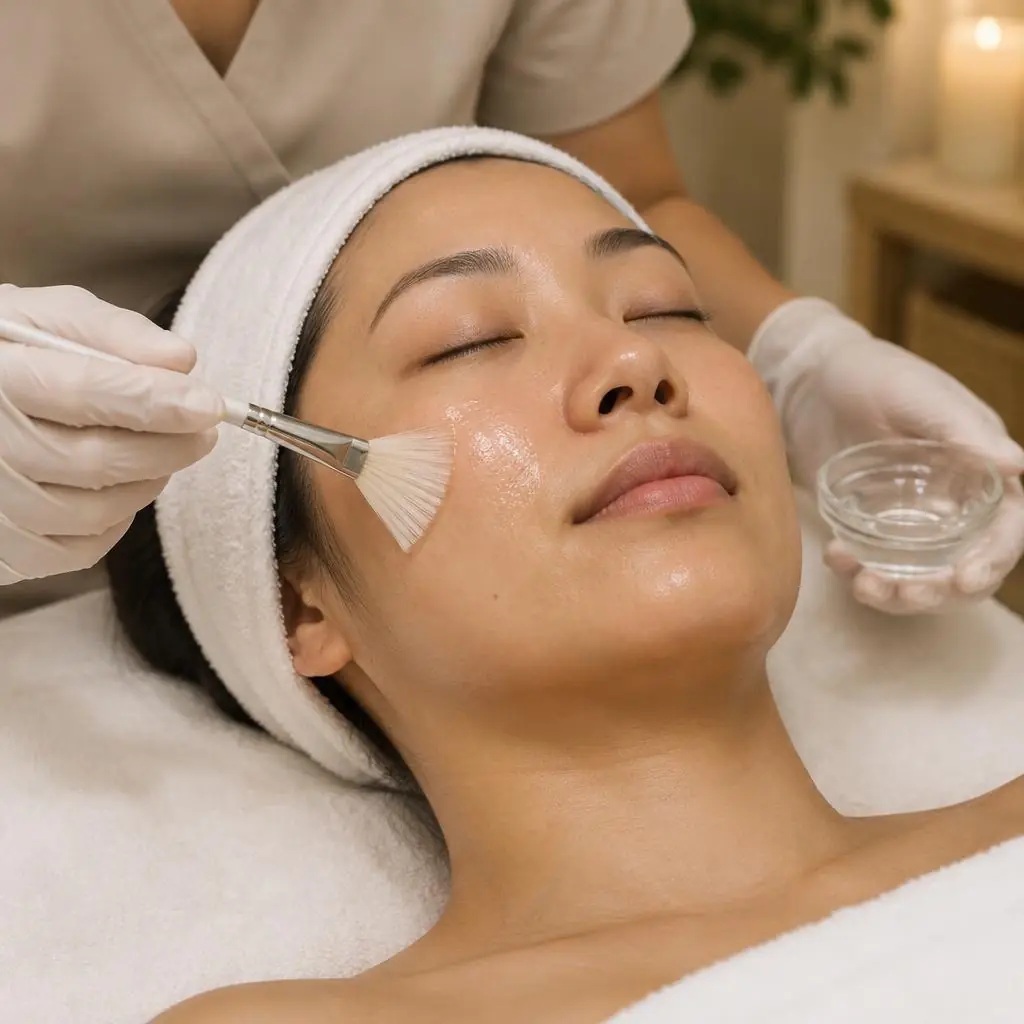
The selected peel is applied according to its confirmed protocol, with attention to your skin response. Report discomfort promptly rather than judging effectiveness by the intensity of sensation.
after
Follow the specific instructions for the peel actually performed. Ask about expected changes, product use, sun protection, follow-up, and symptoms that require advice instead of relying on generic online recovery schedules.
Is it right for you?
A consultation or referral may be appropriate when:
- Active infection, sunburn, open skin, or unexplained inflammation may require postponement or medical assessment.
- A history of post-inflammatory pigmentation should shape the risk discussion and aftercare planning.
- Pregnancy or breastfeeding requires review of the exact proposed formulation rather than assumptions based on a service name.
- Recent procedures and medications may affect skin tolerance or healing and may require clinician input.
- A changing, unusual, or suspicious pigmented lesion should be medically assessed rather than treated as routine discoloration.
Preparation
- Bring a complete skincare list so overlapping exfoliation and potentially irritating combinations can be reviewed.
- Tell the spa about previous cold sores, allergies, unusual healing, and reactions to professional treatments.
- Ask how to coordinate hair removal, other procedures, and upcoming outdoor activities.
- Do not stop prescribed medication without guidance from your treating clinician.
- Avoid arriving with sunburn or newly irritated skin and expecting a stronger treatment to correct it.
Aftercare
- Follow instructions for the exact peel performed rather than borrowing a recovery plan from another treatment.
- Use suitable broad-spectrum sunscreen and minimize avoidable exposure with shade and protective clothing.
- Do not pick or pull at flaking skin, because added injury can increase irritation and pigment changes.
- Resume optional exfoliants, active products, and other procedures only as advised for your treatment.
- Seek advice for unexpected symptoms and medical assessment for significant swelling, blistering, worsening pain, or signs of infection.
Preparation and aftercare above are general guidance; your provider gives final instructions for your appointment.
Realistic expectations
- Visible change varies with the concern, selected protocol, individual skin response, and ongoing home care.
- Peeling can be subtle or more noticeable; the amount of shedding does not reliably measure success.
- One peel cannot be promised to erase pigmentation, eliminate acne, or remove established scars.
- Your esthetician will confirm whether follow-up treatment is appropriate rather than assuming a fixed series is necessary.
How it compares
These options differ in purpose and protocol; the comparison is a starting point for questions, not a ranking from mildest to strongest.
| Option | Best for | Experience | Downtime |
|---|---|---|---|
| Antioxidant Peel | Clients exploring the spa service listed under this descriptive name. | Exact formulation and application require confirmation. | Depends on the confirmed protocol and individual response. |
| Hyperpigmentation Facial | Clients prioritizing an assessment of uneven-looking tone. | A concern-led facial discussion rather than a preselected peel. | Depends on the treatment steps considered appropriate. |
| Microneedling | Clients comparing a separate procedure for suitable texture-related concerns. | Controlled needle treatment rather than chemical exfoliation. | Requires a separate recovery and suitability discussion. |
Planning your visit from Lawrence, KS
Lawrence is home to the University of Kansas and a lively downtown along Massachusetts Street, west of the metro on K-10.
We don’t have an office in Lawrence. We welcome clients from Lawrence at our Overland Park spa — 11740 W 135th St, Suite 4, Overland Park, KS 66221, inside KC Injectables Med Spa. Major roads in and around Lawrence include K-10, I-70, US-59; the Google Maps directions link below gives you live routing and timing.
Compare peel options at our single spa location in Lee’s Summit.