Planning Your Visit from Glenaire to Lee's Summit
Glenaire is a peaceful, small residential city bordered by Liberty in Clay County, offering quiet streets and a close-knit neighborhood feel. Because our single spa facility is located at 286 SW Blue Parkway, Suite 2, in Lee’s Summit, inside KC Injectables Med Spa, we do not operate an office directly within Glenaire. Clients traveling from the Glenaire residential district generally plan their route south using regional thoroughfares.
A typical route connects from local neighborhood roads out toward Missouri Route 152 or directly down Missouri Route 291 across the Missouri River into Jackson County. Taking Missouri Route 291 provides a straightforward north-south link that leads right toward our Lee’s Summit suite. Preparing for the appointment by mapping your drive ahead of time allows you to arrive relaxed, unhurried, and ready to enjoy your comprehensive facial service.
Clay County Climate and Seasonal Skin Preparation
Living in Clay County means navigating dramatic seasonal shifts, from intense summer humidity to the biting, dry air of midwestern winters. In colder months, indoor heating combined with chilly gusts often causes dead surface cells to accumulate, leaving the complexion looking dull and feeling dry or uneven. During humid summers, an overproduction of natural oil can mix with superficial cellular debris, creating an irregular skin texture.
A dermaplaning enhancement may help lift this superficial buildup away without relying on aggressive tugging or heavy chemical agents. By pairing dermaplaning with a hydrating or balancing facial, our aesthetic professionals work to restore a refreshed feel suited to Kansas City’s unpredictable weather. Clients discover that clearing the skin's top layer can make their seasonal moisturizers and serums perform with greater personal satisfaction.
Understanding What Dermaplaning Does and Does Not Do
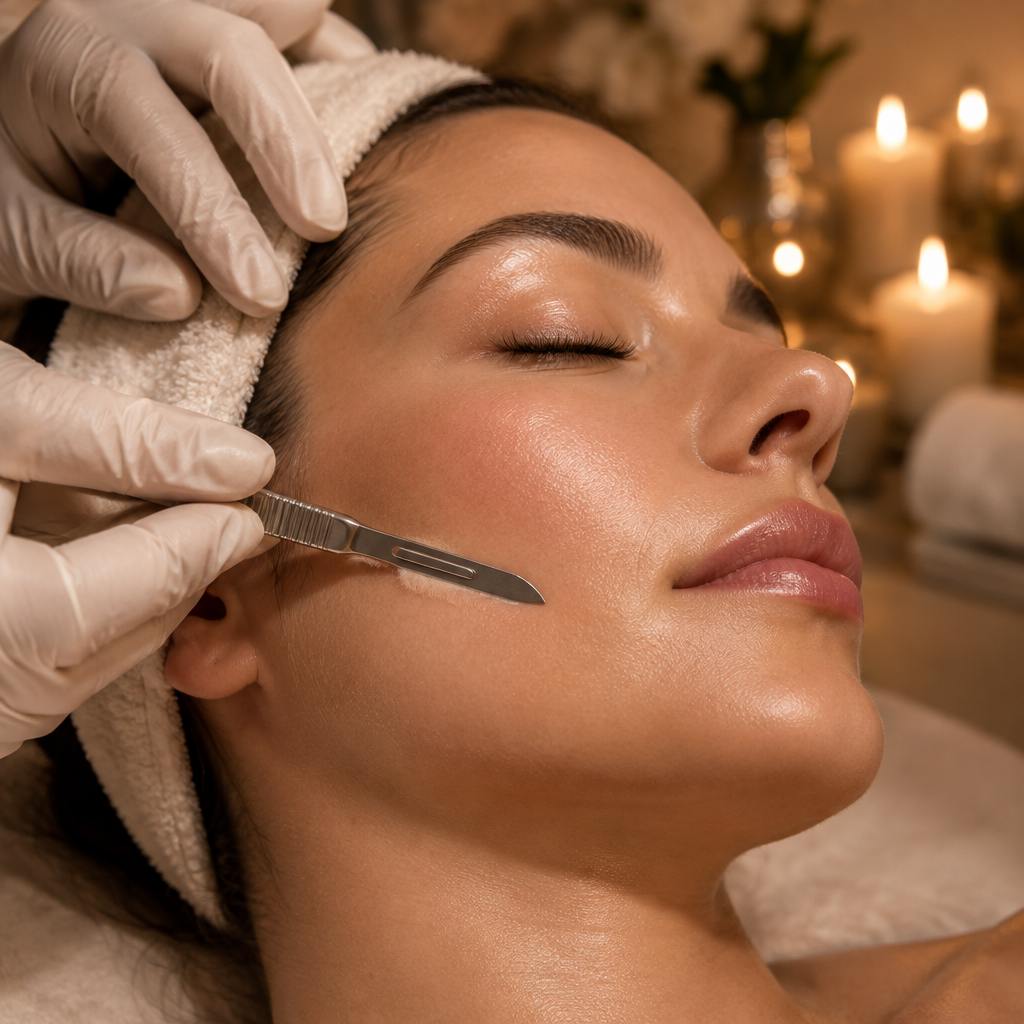
Dermaplaning utilizes a sterile, specialized blade held at an angle to mechanically skim the outermost layer of the stratum corneum alongside fine vellus hair, commonly called peach fuzz. This approach is well suited for individuals who notice their makeup clinging to fine hairs or whose skin feels rough from accumulated superficial cells. Because it is purely a surface-level physical exfoliation, it addresses only the topmost layer of skin.
It is essential to maintain realistic expectations regarding structural skin concerns. Dermaplaning will not remove deep wrinkles, lessen pitted acne scars, or alter underlying pigment issues, nor does it permanently halt hair growth. Fine hair will return naturally on its standard biological cycle. Understanding these distinctions ensures you select the enhancement for its genuine strengths: temporary softness, a cleared surface, and improved cosmetic application.
Dermaplaning Enhancement Versus Other Exfoliation Choices
When comparing mechanical exfoliation to chemical options, many Glenaire clients wonder which pathway best serves their skin goals. Traditional facial scrubs can sometimes cause micro-tears or irritation if their abrasive particles are too harsh or uneven. Chemical peels, meanwhile, rely on acids to loosen cellular bonds, which may penetrate deeper but do not physically remove fine vellus hair in the process.
Dermaplaning provides an immediate manual clearing of surface fuzz and loose dead skin without introducing active peeling acids during the initial pass. For clients with intact skin who dislike gritty scrubs or who want cosmetic smoothness ahead of personal events, dermaplaning serves as a focused alternative. During your consultation, we review your skin health to confirm that manual blade exfoliation is safe and appropriate for your current barrier status.
Aftercare Around Daily Life in the Glenaire Residential District
After your facial enhancement, your newly revealed surface layer will be temporarily more sensitive to environmental factors. For residents returning home to walk along the tree-lined roads of the Glenaire residential district or spend time tending their gardens, robust sun protection is crucial. We advise applying a broad-spectrum mineral sunscreen daily and wearing a brimmed hat when exposed to direct sunlight to prevent irritation and barrier stress.
We also recommend pausing active skincare products, such as retinoids, alpha hydroxy acids, and strong scrubs, for a short period following treatment. Allowing the skin time to settle helps maintain comfort and hydration. By keeping your home routine gentle, focused on calming hydration, you support a supple texture and maximize the refreshed feel achieved during your Lee’s Summit visit.
Who it may suit
- Clients bothered by fine facial hair who understand that removal is temporary and regrowth is part of the normal hair cycle.
- People seeking a smoother skin feel without assuming that surface exfoliation will correct deeper scars or lines.
- Those interested in how makeup sits on the skin and willing to allow time to assess their individual response.
- Facial clients whose skin is intact and suitable for mechanical exfoliation after a professional review.
- Anyone comparing exfoliation methods and wanting a clear explanation of what dermaplaning does differently.
Concerns it may help address
- Fine vellus hair that catches the light or affects personal preferences about facial texture.
- A rough-feeling surface associated with accumulated superficial skin cells rather than a diagnosed disorder.
- Makeup that appears uneven over facial hair, while recognizing other causes of uneven application may remain.
- Confusion between exfoliation, hair removal, and treatments intended for deeper structural changes.
- Uncertainty about combining dermaplaning with active skincare, other procedures, or a first professional facial.
What surface exfoliation can change
Dermaplaning works at the surface. Removing fine hair and some superficial dead skin can change how the skin feels and reflects light, but it does not remodel deeper tissue or eliminate enlarged pores. Visible effects vary with hair distribution, baseline dryness, skin condition, and the rest of your routine.
The removed hair does not become biologically thicker because it has been cut. As it grows back, the tip may feel different to you, and individual hair patterns can change for unrelated hormonal reasons. New coarse hair growth or sudden changes deserve a separate discussion with a healthcare professional.
Choosing the facial around the enhancement
Book by asking for a facial that can appropriately include dermaplaning, rather than assuming every facial on the menu can be combined with it. Your esthetician will confirm the base service, available treatment steps, and whether your skin would benefit more from a simpler appointment without additional exfoliation.
More exfoliation is not automatically more effective. A peel, abrasive device, or strong home active may increase irritation when layered with dermaplaning. Any combination needs an intentional protocol and suitability review; the presence of two services on the menu does not establish that they belong in one visit.
Timing the appointment realistically
If an event is your motivation, mention it before booking and avoid treating your first appointment as a guaranteed last-minute solution. Temporary redness, tenderness, small nicks, or irritation are possible. Your esthetician will confirm sensible scheduling based on your history without promising that your skin will look a particular way.
Afterward, the goal is to protect a freshly exfoliated surface rather than immediately chase further smoothness. Follow the recommended routine, avoid picking at any irritated area, and ask before adding another hair-removal or exfoliating treatment. A cautious follow-up plan is more useful than an automatic repeat schedule.
Before, during and after
before
Request a suitable facial with dermaplaning and disclose active breakouts, cold sores, recent procedures, medication, and hair-removal habits. Your esthetician will confirm whether to proceed.
during
The provider assesses suitable areas and performs controlled surface passes where appropriate. Report discomfort promptly; inflamed, damaged, or otherwise unsuitable areas may be avoided or treatment postponed.
after
Your skin may feel smoother, but temporary sensitivity is possible. Receive specific home-care instructions and clarify when makeup, active skincare, and other facial treatments can resume.
Is it right for you?
A consultation or referral may be appropriate when:
- Active inflammatory acne, open lesions, or irritated skin may make dermaplaning inappropriate for affected areas or the entire appointment.
- A current cold sore or other suspected infection should be disclosed before attending so the spa can advise on postponement.
- Recent resurfacing, waxing, or other skin procedures can affect timing and need individual review.
- Medication and medical history may affect skin fragility or healing; your clinician may need to advise.
- Known reactions to treatment products should be discussed even though the blade technique itself is mechanical.
Preparation
- Provide a current skincare and medication list without independently stopping prescribed treatments.
- Ask how to coordinate recent or planned waxing, threading, shaving, and other exfoliating procedures.
- Avoid experimenting with strong new products before the appointment, especially if your skin is already unsettled.
- Tell the spa about active lesions or sunburn before arriving rather than expecting them to be treated around automatically.
- Mention important events so appointment timing can account for uncertainty in your individual response.
Aftercare
- Follow the recommended gentle cleansing and moisturizing approach rather than immediately using extra exfoliation.
- Use suitable broad-spectrum sunscreen alongside shade and protective clothing to reduce sun exposure.
- Ask your esthetician when to resume optional actives, hair removal, and any planned professional procedures.
- Avoid picking, rubbing, or repeatedly touching areas that feel tender or look irritated.
- Seek medical advice for spreading redness, increasing pain, discharge, or other signs that suggest more than mild temporary irritation.
Preparation and aftercare above are general guidance; your provider gives final instructions for your appointment.
Realistic expectations
- A smoother feel is possible, but the degree and persistence of visible change differ between clients.
- Hair removal is temporary, and dermaplaning is not a substitute for permanent hair-reduction methods.
- The treatment does not erase acne scars, remove deep lines, or permanently shrink pores.
- Your esthetician will confirm whether repeating the enhancement makes sense after reviewing your response.
How it compares
Choose according to the concern you want to address, not the assumption that every exfoliating treatment produces the same result.
| Option | Best for | Experience | Downtime |
|---|---|---|---|
| Hydradermabrasion Enhancement | Clients exploring a different form of surface-focused facial enhancement. | Device-assisted care rather than blade-based removal of fine hair. | Depends on the confirmed protocol and individual sensitivity. |
| Chemical Peels | Clients considering chemical exfoliation for appropriate cosmetic concerns. | Peel selection and recovery planning replace a hair-removal focus. | Varies by the exact peel, application, and skin response. |
| Sensitive Skin Facial | Skin needing a comfort-first assessment rather than added exfoliation. | A gentler direction that may omit dermaplaning entirely. | Your esthetician will confirm expectations for the chosen steps. |
| Microneedling | Clients exploring a separate procedure for suitable texture-related goals. | Controlled needle treatment rather than superficial hair removal. | Requires its own suitability review and recovery guidance. |
Planning your visit from Glenaire, MO
Glenaire is a small residential city bordered by Liberty in Clay County.
We don’t have an office in Glenaire. We welcome clients from Glenaire at our Lee’s Summit spa — 286 SW Blue Parkway, Suite 2, Lee’s Summit, MO 64063, inside KC Injectables Med Spa. Major roads in and around Glenaire include Missouri Route 291, Missouri Route 152; the Google Maps directions link below gives you live routing and timing.
Request a suitable facial with dermaplaning at our single spa location in Lee’s Summit.