Planning Your Chemical Peel Visit from Leavenworth County
Basehor continues to expand along US-24/40 just west of K-7, drawing residents who appreciate both small-town community spaces and easy access to specialized services across the metro. When considering professional skin resurfacing, many local clients find that dedicated clinical care requires traveling beyond local city limits. Our location on West 135th Street in Overland Park provides a focused environment designed entirely for skin health assessments and professional aesthetic treatments.
Making the trip south along regional routes allows you to step away from daily errands and dedicate time entirely to your complexion goals. Before applying any chemical solution, our providers review your routine, previous aesthetic history, and expectations to determine whether a peel aligns with your immediate goals. This consultation ensures you do not waste time or compromise your skin with formulas that are either too mild to help or too harsh for your barrier.
Choosing professional care outside of Basehor also gives you access to broader treatment perspectives. Rather than trying to self-select a service from an overwhelming menu, you receive guidance rooted in clinical suitability. We help you weigh recovery preferences, daily commitments, and seasonal considerations so that your investment in your skin fits seamlessly into your everyday life.
Evaluating Skin Barrier Readiness and Home Care Routines
A successful chemical peel begins long before an acid solution touches your face. Modern home skincare routines frequently contain concentrated active ingredients, including retinoids, alpha hydroxy acids, and clarifying cleansers. If your skin barrier is already compromised, applying a professional-grade peel may lead to unwanted irritation rather than the refined surface you desire. During your consultation, we carefully assess whether your skin is calm, properly hydrated, and prepared for clinical exfoliation.
Many Basehor clients reach out hoping to address an uneven-looking tone or persistent rough texture across the cheeks and forehead. While chemical resurfacing may help lift away dead surface buildup, it is essential to ensure that underlying dark spots or patches are appropriate for cosmetic exfoliation. Certain forms of pigment react poorly to unguided heat and chemical stress, making professional evaluation an indispensable initial step.
We discuss what products should be temporarily paused prior to your session, ensuring your skin remains resilient throughout the process. Prioritizing skin suitability over a quick fix preserves your natural protective moisture barrier. By adjusting your home regimen in tandem with professional care, you establish a balanced foundation that supports consistent, healthy-looking radiance.
Why Visible Flaking Is Not the Only Measure of Progress
A common misconception about chemical peels is that dramatic, visible sheets of shedding skin are necessary for real improvement. In reality, modern formulation allows for cellular turnover that often works at a microscopic level. Light to medium options can effectively encourage surface renewal without requiring you to endure days of obvious, heavy flaking that disrupts your work or social schedule.
Equating intense peeling with superior results often leads individuals to request the strongest possible formula, which can result in unnecessary redness or moisture loss. Our approach centers on your comfort and desired recovery profile. Whether your goals call for subtle brightening with minimal social downtime or deeper cellular renewal, we focus on the biological response of your tissue rather than the visual theater of peeling skin.
Understanding this distinction helps you plan your recovery with complete confidence. You do not have to hide away at home for an extended period to experience the benefits of chemical exfoliation. We clarify exactly what surface changes to expect in the days following your visit, allowing you to maintain your standard commitments without worrying about sudden, unmanageable flaking.
Adapting Aftercare to Basehor Seasons and Outdoor Living
Living in Leavenworth County often means spending time outside, whether you are walking along 155th Street, watching community sports at Basehor City Park, or picking up books at the Basehor Community Library. However, newly exfoliated skin is exceptionally sensitive to environmental stressors. The regional climate swings from humid, sun-drenched summers to cold, windy winter months, both of which require proactive adjustments to your post-peel aftercare routine.
Sun protection becomes non-negotiable after any exfoliating treatment. Freshly revealed skin cells lack their typical protective layers, leaving them vulnerable to ultraviolet exposure that can rapidly trigger dark patches and inflammation. If your routine involves regular outdoor recreation around Basehor, we will help you plan physical shade, broad-spectrum sunscreen application, and heat-avoidance strategies to safeguard your investment.
Cold Kansas winds also pose a challenge by stripping essential moisture from delicate post-procedure skin. During cooler months, your post-peel focus must pivot toward lipid-rich moisturizers and barrier-repairing hydrators. We provide clear, practical instructions that account for local weather conditions, keeping your complexion calm, comfortably nourished, and shielded from harsh seasonal elements.
Differentiating Peels from Facials and Mechanical Procedures
When browsing aesthetic services, it is easy to confuse chemical peels with standard spa facials or mechanical treatments like microneedling. While classic facials excel at surface cleansing and temporary hydration, they rarely alter cellular turnover rates. Chemical peels rely on specific acid compounds to dissolve the bonds between aged skin cells, stimulating deeper renewal that may help improve tone and smooth surface irregularities.
Conversely, mechanical treatments utilize precise physical stimulation rather than chemical exfoliation to support collagen production. Deciding between these categories depends on what you want to achieve. If your primary concerns involve dullness, rough buildup, or mild superficial discoloration, chemical solutions often serve as the most logical starting point for renewing your skin's surface.
By clearly distinguishing these mechanisms, we prevent you from choosing a treatment that does not match your primary cosmetic concern. During your visit from Basehor, we evaluate your tissue's density, oil production, and sensitivity to recommend the modality best aligned with your needs. This thoughtful, educational process ensures every treatment has a clear, defined purpose.
Who it may suit
- People deciding whether a peel is the right category of treatment before selecting a named service.
- Clients comparing cosmetic goals such as surface texture, dullness, or uneven-looking tone with realistic recovery preferences.
- Those who want an explanation of how skin history and home products influence peel selection.
- People willing to prioritize suitability over a preference for the strongest-sounding treatment.
- Clients seeking a clear distinction between professional exfoliation, supportive facials, and procedures with different mechanisms.
Concerns it may help address
- Uneven-looking tone that needs assessment before assuming every dark mark is appropriate for cosmetic treatment.
- Rough surface texture when the skin is not already irritated by excessive exfoliation.
- Dullness that prompts a discussion about realistic benefits rather than a guaranteed transformation.
- Confusion about whether visible peeling is necessary or indicates a better result.
- Uncertainty about comparing branded peel names with descriptive service names and general facial options.
Compare the decision factors, not just the names
A useful peel consultation starts with what you want to change and what your skin can tolerate. Your provider should know about previous reactions, pigmentation after irritation, recent procedures, medications, and the products you use at home. These details can matter more than an appealing treatment name.
Recovery is another decision factor, but it cannot be predicted from marketing language alone. Ask what reactions are reasonably possible with the proposed protocol, how aftercare fits your schedule, and what might require postponement. A quieter-looking recovery does not automatically mean a treatment was ineffective.
Where the Antioxidant Peel fits
Antioxidant Peel also has a dedicated page, but its service name does not establish a universal ingredient list or level of intensity. The spa will confirm its exact formulation and protocol. Use its dedicated page to prepare questions, then compare confirmed details with a facial or enhancement.
When a different service may make more sense
A facial focused on hydration or comfort may be a better starting point when skin is dry, reactive, or recovering from excessive product use. Choosing not to peel is a valid outcome of a consultation. Cosmetic treatment should not proceed simply because a particular service was initially requested.
Microneedling and other procedures address concerns through different mechanisms and require their own suitability assessments. They are not interchangeable upgrades to a peel. Persistent acne, unexplained pigmentation, suspicious lesions, or ongoing inflammation may need medical assessment before a spa treatment plan is considered.
Before, during and after
before
Discuss your main goal, previous peel experiences, pigmentation history, medications, and routine. Your esthetician will confirm the available option, protocol, and whether treatment should proceed.
during
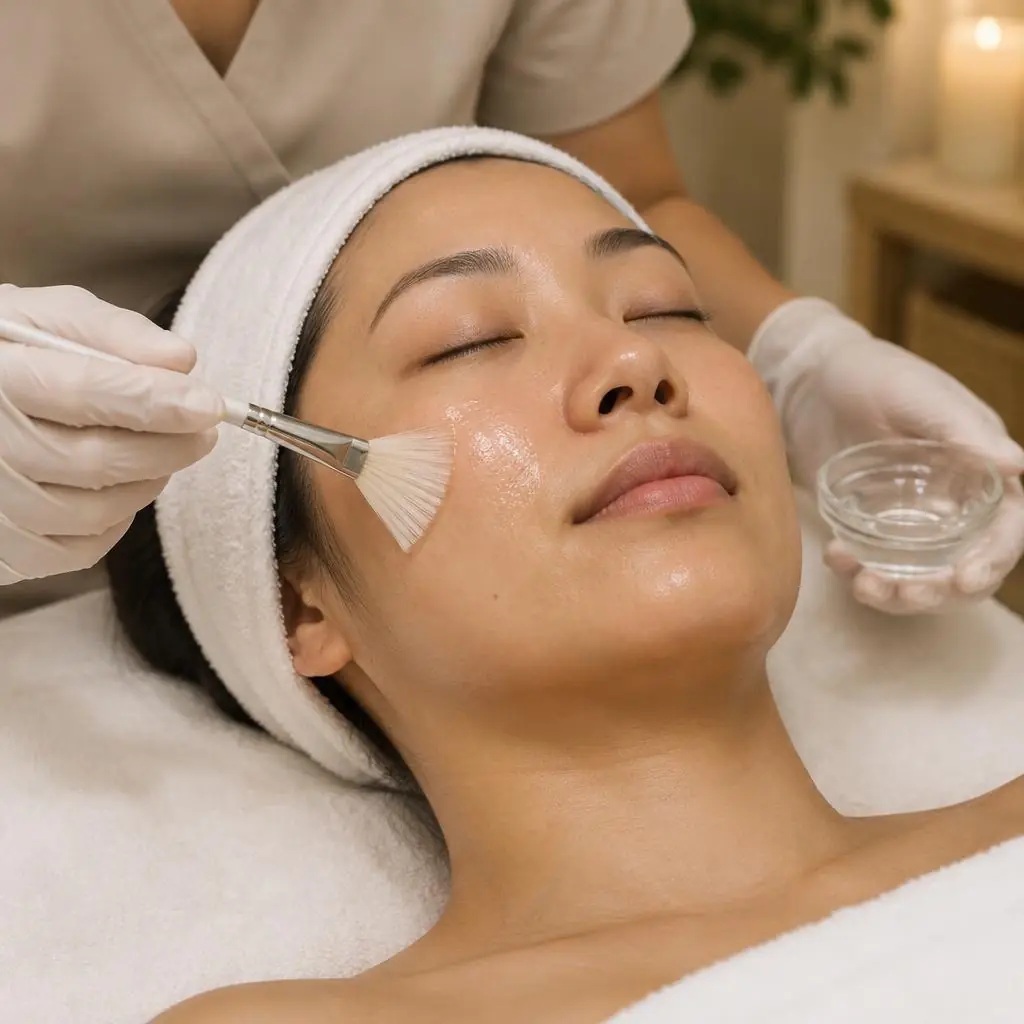
The selected peel is applied according to its confirmed protocol, with attention to your skin response. Report discomfort promptly rather than judging effectiveness by the intensity of sensation.
after
Follow the specific instructions for the peel actually performed. Ask about expected changes, product use, sun protection, follow-up, and symptoms that require advice instead of relying on generic online recovery schedules.
Is it right for you?
A consultation or referral may be appropriate when:
- Active infection, sunburn, open skin, or unexplained inflammation may require postponement or medical assessment.
- A history of post-inflammatory pigmentation should shape the risk discussion and aftercare planning.
- Pregnancy or breastfeeding requires review of the exact proposed formulation rather than assumptions based on a service name.
- Recent procedures and medications may affect skin tolerance or healing and may require clinician input.
- A changing, unusual, or suspicious pigmented lesion should be medically assessed rather than treated as routine discoloration.
Preparation
- Bring a complete skincare list so overlapping exfoliation and potentially irritating combinations can be reviewed.
- Tell the spa about previous cold sores, allergies, unusual healing, and reactions to professional treatments.
- Ask how to coordinate hair removal, other procedures, and upcoming outdoor activities.
- Do not stop prescribed medication without guidance from your treating clinician.
- Avoid arriving with sunburn or newly irritated skin and expecting a stronger treatment to correct it.
Aftercare
- Follow instructions for the exact peel performed rather than borrowing a recovery plan from another treatment.
- Use suitable broad-spectrum sunscreen and minimize avoidable exposure with shade and protective clothing.
- Do not pick or pull at flaking skin, because added injury can increase irritation and pigment changes.
- Resume optional exfoliants, active products, and other procedures only as advised for your treatment.
- Seek advice for unexpected symptoms and medical assessment for significant swelling, blistering, worsening pain, or signs of infection.
Preparation and aftercare above are general guidance; your provider gives final instructions for your appointment.
Realistic expectations
- Visible change varies with the concern, selected protocol, individual skin response, and ongoing home care.
- Peeling can be subtle or more noticeable; the amount of shedding does not reliably measure success.
- One peel cannot be promised to erase pigmentation, eliminate acne, or remove established scars.
- Your esthetician will confirm whether follow-up treatment is appropriate rather than assuming a fixed series is necessary.
How it compares
These options differ in purpose and protocol; the comparison is a starting point for questions, not a ranking from mildest to strongest.
| Option | Best for | Experience | Downtime |
|---|---|---|---|
| Antioxidant Peel | Clients exploring the spa service listed under this descriptive name. | Exact formulation and application require confirmation. | Depends on the confirmed protocol and individual response. |
| Hyperpigmentation Facial | Clients prioritizing an assessment of uneven-looking tone. | A concern-led facial discussion rather than a preselected peel. | Depends on the treatment steps considered appropriate. |
| Microneedling | Clients comparing a separate procedure for suitable texture-related concerns. | Controlled needle treatment rather than chemical exfoliation. | Requires a separate recovery and suitability discussion. |
Planning your visit from Basehor, KS
Basehor is a growing Leavenworth County community along US-24/40 west of K-7.
We don’t have an office in Basehor. We welcome clients from Basehor at our Overland Park spa — 11740 W 135th St, Suite 4, Overland Park, KS 66221, inside KC Injectables Med Spa. Major roads in and around Basehor include US-24/40, K-7; the Google Maps directions link below gives you live routing and timing.
Compare peel options at our single spa location in Lee’s Summit.