Planning Your Visit from Sugar Creek to Lee’s Summit
Sugar Creek sits along the Missouri River between Kansas City and Independence, offering quiet neighborhoods and scenic bluff views. When you are ready for professional exfoliation, visiting our single facility at 286 SW Blue Parkway, Suite 2, inside KC Injectables Med Spa in Lee’s Summit is straightforward. Many clients travel south by connecting with US-24 and heading down I-435, making the trip easy to coordinate around work or weekend errands.
Because an effective chemical peel requires dedicated attention to your skin's immediate condition, planning your route ahead of time lets you arrive relaxed. We do not operate a clinic within Sugar Creek itself, so every consultation and treatment is hosted at our Lee’s Summit location. This dedicated setting ensures you receive an in-depth evaluation of your cosmetic goals in an environment focused entirely on thoughtful skin care.
How River Bluffs Weather Affects Exfoliation Needs
Living near the Missouri River bluffs brings notable shifts in local humidity and seasonal temperatures across western Missouri. Humid summer air can leave pores feeling congested from sweat and outdoor moisture, while dry winter cold snaps strip away vital surface hydration. Chemical peels may help manage uneven-looking texture and persistent dullness brought on by these dramatic seasonal swings, provided your moisture barrier remains intact and calm.
If your skin is currently parched or irritated by windburn, applying a professional chemical exfoliant could cause excess irritation instead of healthy renewal. During your appointment, we evaluate whether your complexion is adequately hydrated to tolerate an acid application or if a supportive facial should come first. Aligning treatment intensity with the current Missouri season ensures your barrier remains resilient and protected throughout the entire process.
Managing Aftercare Around Sugar Creek Outdoor Routines
Whether you enjoy walking through historic Downtown Sugar Creek or exploring trails along the river bluffs, post-peel aftercare requires conscious sun defense. Chemical peels work by dissolving the bonds holding dull, dead cells together, leaving fresh skin underneath temporarily vulnerable to ultraviolet light. Exposure to direct sunlight right after an appointment can trigger unintended dark spots and interrupt your skin's natural recovery process.
We encourage clients to schedule their sessions when they can spend a few days resting indoors away from intense sun exposure. Applying daily broad-spectrum sun protection, wearing a wide-brimmed hat, and avoiding heavy outdoor workouts that produce profuse sweating are essential steps. Planning your appointment around your outdoor routines helps protect your skin investment and supports a smoother, more comfortable recovery period.
Clarifying Visible Peeling Versus Effective Exfoliation
A common misconception among clients comparing peel options is that heavy, sheet-like peeling is required to prove a treatment worked. In reality, the amount of visible flaking often reflects product depth and individual hydration levels rather than true cosmetic success. Gentle professional solutions may help refine rough texture and improve the appearance of dullness with minimal to no visible shedding during recovery.
Opting for the strongest-sounding formulation can sometimes overwhelm the skin, leading to prolonged redness or unwanted sensitivity. We prioritize long-term skin health over aggressive peeling that disrupts your daily routine. By discussing your comfort level with recovery downtime and your visual goals, we can identify a balanced formula that encourages cellular turnover without unnecessarily irritating your complexion.
How Home Care and Skin History Shape Your Options
Before choosing any chemical exfoliation option, evaluating your current home routine is a critical safety step. Active ingredients like prescription retinoids, exfoliating alpha hydroxy acids, or abrasive physical scrubs alter the thickness and permeability of your outer skin layers. If these products have already thinned your skin barrier, applying a professional peel could heighten reactivity and produce an uneven result.
We review the specific products you apply morning and evening, along with any personal history of dark marks or skin reactivity. This thorough assessment ensures we never apply an active formula to compromised tissue. In some instances, adjusting your home care routine or selecting a non-acid facial service provides a safer, more predictable approach toward addressing uneven-looking tone and rough surface texture.
Who it may suit
- People deciding whether a peel is the right category of treatment before selecting a named service.
- Clients comparing cosmetic goals such as surface texture, dullness, or uneven-looking tone with realistic recovery preferences.
- Those who want an explanation of how skin history and home products influence peel selection.
- People willing to prioritize suitability over a preference for the strongest-sounding treatment.
- Clients seeking a clear distinction between professional exfoliation, supportive facials, and procedures with different mechanisms.
Concerns it may help address
- Uneven-looking tone that needs assessment before assuming every dark mark is appropriate for cosmetic treatment.
- Rough surface texture when the skin is not already irritated by excessive exfoliation.
- Dullness that prompts a discussion about realistic benefits rather than a guaranteed transformation.
- Confusion about whether visible peeling is necessary or indicates a better result.
- Uncertainty about comparing branded peel names with descriptive service names and general facial options.
Compare the decision factors, not just the names
A useful peel consultation starts with what you want to change and what your skin can tolerate. Your provider should know about previous reactions, pigmentation after irritation, recent procedures, medications, and the products you use at home. These details can matter more than an appealing treatment name.
Recovery is another decision factor, but it cannot be predicted from marketing language alone. Ask what reactions are reasonably possible with the proposed protocol, how aftercare fits your schedule, and what might require postponement. A quieter-looking recovery does not automatically mean a treatment was ineffective.
Where the Antioxidant Peel fits
Antioxidant Peel also has a dedicated page, but its service name does not establish a universal ingredient list or level of intensity. The spa will confirm its exact formulation and protocol. Use its dedicated page to prepare questions, then compare confirmed details with a facial or enhancement.
When a different service may make more sense
A facial focused on hydration or comfort may be a better starting point when skin is dry, reactive, or recovering from excessive product use. Choosing not to peel is a valid outcome of a consultation. Cosmetic treatment should not proceed simply because a particular service was initially requested.
Microneedling and other procedures address concerns through different mechanisms and require their own suitability assessments. They are not interchangeable upgrades to a peel. Persistent acne, unexplained pigmentation, suspicious lesions, or ongoing inflammation may need medical assessment before a spa treatment plan is considered.
Before, during and after
before
Discuss your main goal, previous peel experiences, pigmentation history, medications, and routine. Your esthetician will confirm the available option, protocol, and whether treatment should proceed.
during
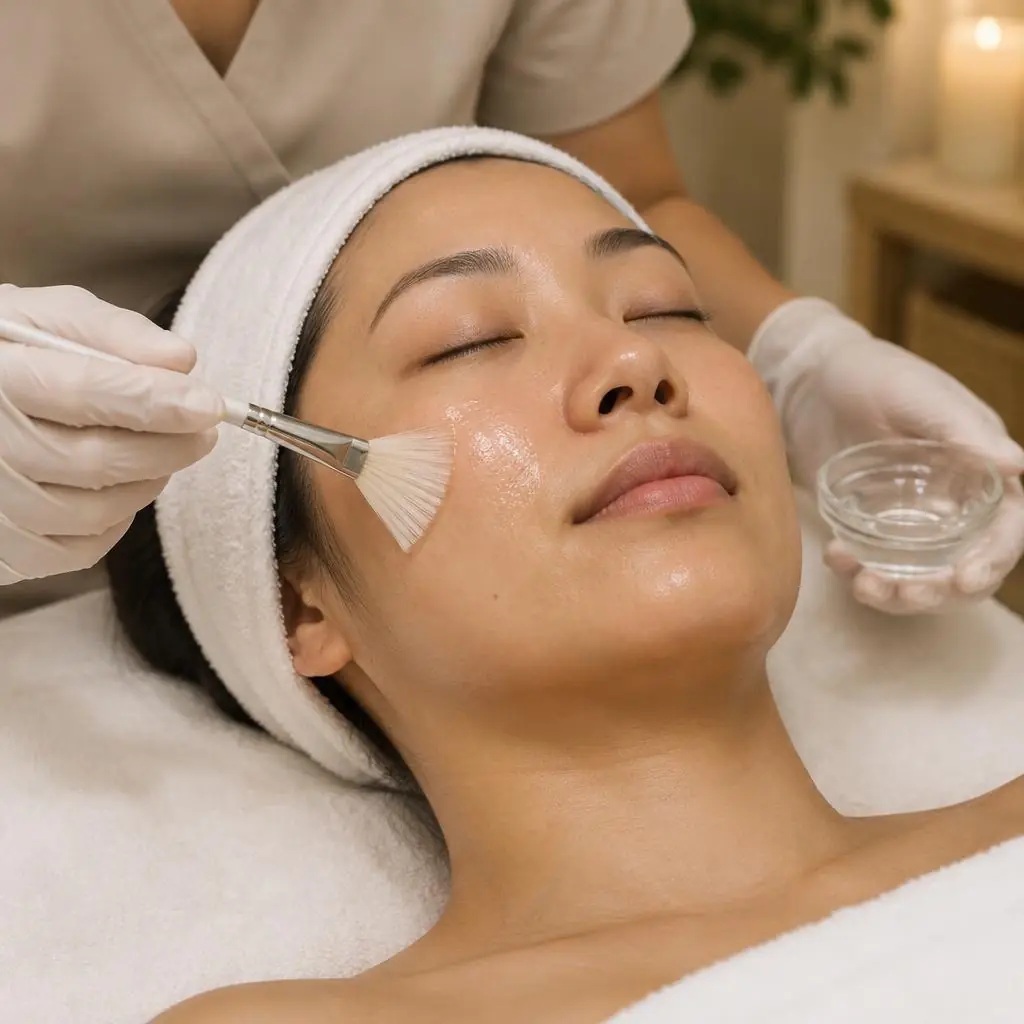
The selected peel is applied according to its confirmed protocol, with attention to your skin response. Report discomfort promptly rather than judging effectiveness by the intensity of sensation.
after
Follow the specific instructions for the peel actually performed. Ask about expected changes, product use, sun protection, follow-up, and symptoms that require advice instead of relying on generic online recovery schedules.
Is it right for you?
A consultation or referral may be appropriate when:
- Active infection, sunburn, open skin, or unexplained inflammation may require postponement or medical assessment.
- A history of post-inflammatory pigmentation should shape the risk discussion and aftercare planning.
- Pregnancy or breastfeeding requires review of the exact proposed formulation rather than assumptions based on a service name.
- Recent procedures and medications may affect skin tolerance or healing and may require clinician input.
- A changing, unusual, or suspicious pigmented lesion should be medically assessed rather than treated as routine discoloration.
Preparation
- Bring a complete skincare list so overlapping exfoliation and potentially irritating combinations can be reviewed.
- Tell the spa about previous cold sores, allergies, unusual healing, and reactions to professional treatments.
- Ask how to coordinate hair removal, other procedures, and upcoming outdoor activities.
- Do not stop prescribed medication without guidance from your treating clinician.
- Avoid arriving with sunburn or newly irritated skin and expecting a stronger treatment to correct it.
Aftercare
- Follow instructions for the exact peel performed rather than borrowing a recovery plan from another treatment.
- Use suitable broad-spectrum sunscreen and minimize avoidable exposure with shade and protective clothing.
- Do not pick or pull at flaking skin, because added injury can increase irritation and pigment changes.
- Resume optional exfoliants, active products, and other procedures only as advised for your treatment.
- Seek advice for unexpected symptoms and medical assessment for significant swelling, blistering, worsening pain, or signs of infection.
Preparation and aftercare above are general guidance; your provider gives final instructions for your appointment.
Realistic expectations
- Visible change varies with the concern, selected protocol, individual skin response, and ongoing home care.
- Peeling can be subtle or more noticeable; the amount of shedding does not reliably measure success.
- One peel cannot be promised to erase pigmentation, eliminate acne, or remove established scars.
- Your esthetician will confirm whether follow-up treatment is appropriate rather than assuming a fixed series is necessary.
How it compares
These options differ in purpose and protocol; the comparison is a starting point for questions, not a ranking from mildest to strongest.
| Option | Best for | Experience | Downtime |
|---|---|---|---|
| Antioxidant Peel | Clients exploring the spa service listed under this descriptive name. | Exact formulation and application require confirmation. | Depends on the confirmed protocol and individual response. |
| Hyperpigmentation Facial | Clients prioritizing an assessment of uneven-looking tone. | A concern-led facial discussion rather than a preselected peel. | Depends on the treatment steps considered appropriate. |
| Microneedling | Clients comparing a separate procedure for suitable texture-related concerns. | Controlled needle treatment rather than chemical exfoliation. | Requires a separate recovery and suitability discussion. |
Planning your visit from Sugar Creek, MO
Sugar Creek sits along the Missouri River between Kansas City and Independence.
We don’t have an office in Sugar Creek. We welcome clients from Sugar Creek at our Lee’s Summit spa — 286 SW Blue Parkway, Suite 2, Lee’s Summit, MO 64063, inside KC Injectables Med Spa. Major roads in and around Sugar Creek include I-435, US-24; the Google Maps directions link below gives you live routing and timing.
Compare peel options at our single spa location in Lee’s Summit.